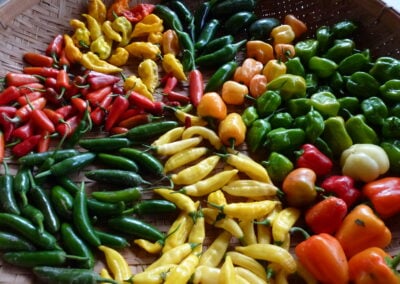
Capsicum frutescens ‘Tabasco’
As someone with a love of horticulture, I wish that I had studied Latin in high school. It is such an integral part of knowing plants well. Instead, I studied Spanish, which has been useful as I work in the landscape industry in the South and am able to put it to use on a daily basis. Yet, it is never too late to learn something new. I’ll probably never get into Latin conjugations or reading texts in Latin, but learning a bit of the vocabulary is very helpful and, to me, very interesting. Thus, I’m writing a series of articles on Latin words and how they relate to plants and botanical nomenclature in order to learn more and to share with you. Let’s start with a look at Latin words used in botanical names to relate to the senses. Here is a list of some that relate to the senses of taste and sound:
acerbus—harsh or sour tasting
acetosellus—slightly acid
acris—acrid
amarus—bitter
blandus—mild; not bitter; pleasing
capsicum—biting to the taste; hot (as in peppers)
causticus—burning to the taste
cibarius—edible; useful for food
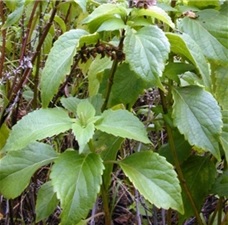
Ocimum gratissiumum, clove basil–a “very pleasing” basil indeed
cynara—bitter to the taste
dulcamara—bittersweet to the taste
edulis—edible
emeticus—emetic
esculentus—edible; tasty
gratissimum—very pleasing; agreeable
saccharinus—sweet; containing sugars
saccharum—of sugar
sapidus—savory; pleasing to the taste
Examples of use:
Capsicum frutescens – (chile pepper) shrubby plant with fruit biting to the taste
Colocasia esculenta – (taro) tropical plant with large, edible corms
Cynara cardunculus – (cardoon) bitter plant resembling a thistle
Passiflora edulis – (passion fruit) passionflower with edible fruit
Solanum dulcamara – (bitter (deadly) nightshade) – bitter because it is poisonous
Note: Any time we use a scientific species name it should be italicized (note the names above). The Latin binomial naming system is used to describe a species of plant, animal, bacterium, fungus, or other living organism. The first of the two names is the genus name and the second is the specific epithet. Together, they give us the species name. As humans, our genus is Homo and our specific epithet is sapiens. Thus the species for humans is Homo sapiens.
I only found one botanical Latin word that relates to sound:
onopordum—meaning “ass-fart”
 Onopordum acanthium is the Scotch thistle – a stately emblem of its country. It is reputedly eaten by donkeys (asses) and results in flatulence (farting). If you know of any other botanical Latin names that relate to sound, please let me know. I’d like to add more to this list. Could they possibly be any more intriguing than this one?
I’ll be writing more about how Latin words relate to the other senses, colors, shapes, habitats, origins, and more with an emphasis on herbal plants. Hopefully, you will learn a few things and come to see how a bit of knowledge about these words makes botanical nomenclature more understandable and less daunting.
There are some good books on the subject if you want to learn more than what I am able to write about in these blogs. Here is a list of some I find useful and have used as references:
Bird, Richard. 2015. A Gardener’s Latin. London, England : National Trust.
Harrison, Lorraine. 2012. Latin for Gardeners. Chicago, IL: The University of Chicago Press.
Neal, Mill. 1992. Gardener’s Latin. Chapel Hill, NC: Algonquin Books of Chapel Hill.