
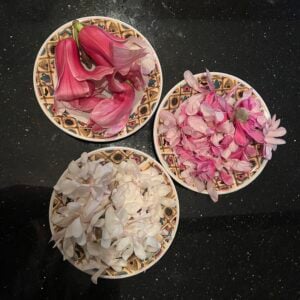
 For a while I was working in a bakery. Most of my coworkers loved to experiment with new foods and unique flavors and I was often introduced to things I had never tried before through this experience. One day, one of my coworkers brought in a magnolia simple syrup she had made. It was such a beautiful bright pink with a nice gingery-sweet flavor. This syrup was an embodiment of the taste of spring.
So, I decided to do an experiment of my own and tried making magnolia syrup with a few different cultivars to see how the flavor differed. I decided to use three earlier blooming magnolias: Magnolia × soulangeana ‘Pickard’s Schmetterling’ saucer magnolia, Magnolia × loebneri ‘Leonard Messel’ Loebner magnolia, and Magnolia stellata ‘Royal Star’ white star magnolia. Each variety I chose was a different shape, size, and color.
Magnolia simple syrup recipe:
50 grams magnolia flowers (2-3 flowers)
50 grams sugar (1/4 cup)*
250 ml water (1 cup)
1/4 tsp citric acid (optional)
- Combine water and sugar and bring to a boil until sugar is dissolved.
- While boiling, add magnolia flowers and return syrup to a boil.
- Once boiling again, add citric acid and let it dissolve. Remove from heat, then chill syrup in the fridge.
- After chilling you can strain out flowers from syrup (optional)
*If you want the syrup to be sweeter, add equal amounts of sugar and water when making simple syrup
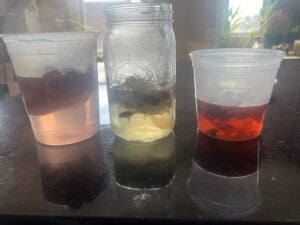
Out of the three, I think my favorite was the Magnolia × loebneri ‘Leonard Messel’. This syrup has a nice robust pink color, as well as a rich, sweet, yet floraly-gingery taste.
The Magnolia × soulangeana ‘Pickard’s Schmetterling’ was a very light pink in color and had a more mellow taste to its syrup. This one was pleasant and slightly gingery.
The Magnolia stellata ‘Royal Star’ had a slight bitter taste that I was not as inclined to in my palette. While still sweet, it was much less gingery. As flowers mature, their flavor tends to become more bitter.
Magnolias first evolved during the Cretaceous period, 95 million years ago. One thing I’ve always found interesting about these ancient flowers is how they are pollinated by beetles rather than bees, as they have existed since before bees evolved.
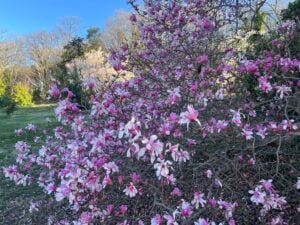
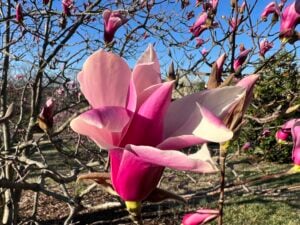
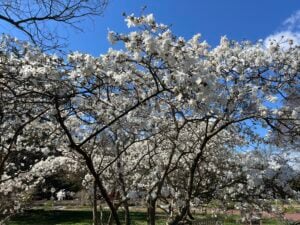
Magnolia trees are native to the East Coast of the US, Eastern Asia, and Central America. All parts of the plant have been used in traditional medicine across the globe. The root and bark of the trees have long been used in Traditional Chinese, Korean, and Japanese medicines to help treat allergies, gastrointestinal problems, and anxiety (Poivre 2017). The flowers of the plant are also used medicinally to treat sinus congestion and headaches in both TCM and by Native Americans. Magnolia flowers can also be pickled and eaten. While I was not making the syrup for any medicinal purposes, I do enjoy knowing a bit more of how this plant has historically been used over the years.
If you try making the syrup I recommend picking the flowers early in the season, since they will be sweeter and more gingery. Any type of magnolia can work for making syrup! Magnolia × soulangeana is thought to be one of the best flavorwise, but let me know your thoughts if you try it!