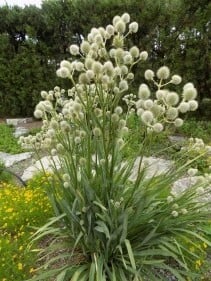
 I first saw Eryngium yuccifolium Michx.—a.k.a rattlesnake master, button eryngo, or button snakeroot—planted at the Gene Leahy Mall, a park in downtown Omaha, Nebraska. A unique pollinator plant that really stands out in the bed, this native medicinal plant is a great addition to any herb garden. Historically, rattlesnake master has been used as a diuretic, diaphoretic (inducing sweating), expectorant, and, in large doses, an emetic (inducing vomiting) (King, 1905).
This perennial grows in midwestern prairies, savannas, swamps, and open woods across 23 states, from Florida to Maryland and Texas to Minnesota (Brakie, 2021). A warm-season, tap-rooted perennial, E. yuccifolium grows in medium to dry soils and loves full sun. Its bristly basal foliage resembles that of yucca (Yucca sp.)—hence the specific epithet—but rattlesnake master is in the Apiaceae family, the same as celery, carrot, and parsley. Each showy, whitish-green, round flower head is reminiscent of thistles and can last up to a month, blooming from June to September. Many pollinators love this plant, including black swallowtail butterflies, which use it as a larval host (Brakie, 2021). The seedheads persist until winter, giving multi-season interest in the garden, and the stems provide winter homes for insects (Lady Bird Johnson Wildflower Center, 2024). In ideal growing conditions, it can self-seed—watch out for this and deadhead if you don’t want volunteers! The plants can be propagated by division and have few pest issues (Missouri Botanical Garden, 2024).
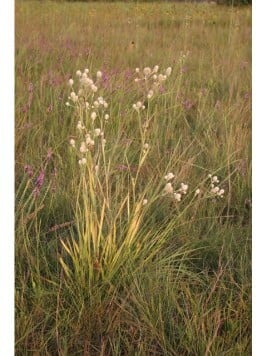 The common name, “rattlesnake master,” was first recorded in John Adair’s book, (1775). This common name is also found in ethnobotanical accounts from the Muscogee (formerly called the Creek), Cherokee, Meskwaki, and Natchez tribes. Though ethnobotanical accounts differ on usages for rattlesnake master among various tribes/nations, all state this plant can be used to treat rattlesnake bites (Kindscher, 1992; NAED, 2003; Vogel, 1977). Today, however, this is not recommended. Among the Muscogee, the roots are taken as an analgesic (pain reliever), antirheumatic, blood medicine, gastrointestinal aid, kidney aid, panacea (cure-all), sedative, and venereal aid (NAED, 2003; Vogel, 1977), while the Meskwaki tribe have used it in ceremonial medicine, as an antidote for poisons, and for treating bladder issues (Kindscher, 1992; NAED, 2003).
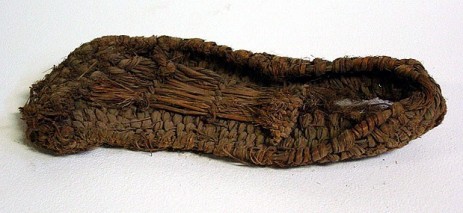 Besides its historical medicinal use, archeologists also consider this multi-purpose plant one of several ancient fiber plants used by native peoples for thousands of years. Slippers, sandals, and moccasins made with rattlesnake master have been found in Kentucky and Missouri. In Salts Cave, Kentucky, researchers identified rattlesnake master leaves as the main fiber used to construct slippers, dated to 1500 BCE (Gordon & Keating, 2001). In Missouri, ornate, complexly woven shoes dating from 1,000 to 8,000 years old have been identified as made with rattlesnake master, including adult- and child-sized slip-ons, sandals, and moccasins (Pringle, 1998).
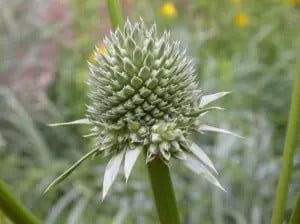 While rattlesnake master isn’t currently represented in the National Herb Garden (NHG), it’s in the same genus as E. planum. Also known as blue sea holly, E. planum can be found in the NHG’s Dioscorides theme bed, having been mentioned in his historical text from the 1st century A.D. I first encountered blue sea holly in my grandma’s perennial bed. Native to Central Asia and Europe, blue sea holly is a medicinal plant like its American cousin, but is used to treat inflammatory disorders and, reputedly, epilepsy. Though similar in appearance to rattlesnake master, the flowers differ in color.
With its showy flowers, rattlesnake master can be a great native, pollinator-friendly alternative to its more commonly planted Eurasian relative. So, if you’re looking to mix up your herb garden, consider planting Eryngium yuccifolium this year!