The prickly pear cactus (Opuntia lindheimeri) is in bloom in our Texas meadows now, and the bees are crawling drunkenly over the bright yellow flowers, as large as hollyhock blossoms. We’ve cleared most of this prickly native herb from our meadows because the spines are painful when we carelessly blunder into the plant, or (heaven forbid!) our dogs step on it. But I’ve safeguarded a few, because they’re beautiful and useful and because they remind me that not all plants are easy to get along with.
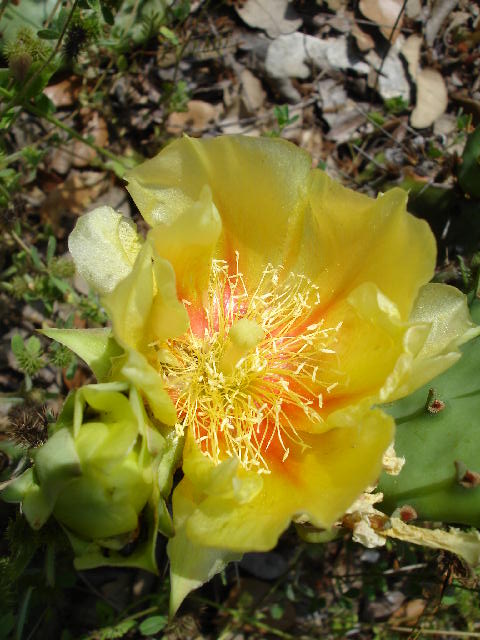
The prickly pear’s translucent yellow flowers ripen into ruby-red fruits, called tunas. I’ve made these into juice, jelly, and syrup. I’ve harvested the young, tender pads, called nopalitos. Do wear leather gloves if you do this: I speak from personal experience when I say that this plant is spiny. If you don’t know a prickly pear up close and personal that will offer you a few pads, you can sometimes find them in your supermarket’s produce section.

Research suggests that the nutrient-rich fiber in the fruits and pads helps to reduce cholesterol. Native peoples singed the spines from the pads, then split and warmed them for use as a poultice to relieve chest congestion. They placed warmed pads over the ears for earache, or over rheumatic or arthritic joints. The gelatinous sap (which is a lot like aloe vera gel) was a soothing skin lotion for rashes and sunburn, and they mashed the flesh of the pad and used it as a poultice to heal wounds and burns. Taken internally, the plant treated many gastrointestinal disorders.
And like most native herbs, prickly pear served many purposes. In rural Mexico, it was used (with water, lime, and salt) to make a durable, waterproof paint for walls, and as a formidable fence—just try getting through that dense, thorny wall! Its fibers were used to make paper and its thorns as needles and pins, while the insect that feeds on its pads and fruit (the cochineal) made red dye. Like many other natives, this durable, adaptable plant has its darker side: free to roam, it can be an invasive pest.
But I’m not thinking about that today, as I revel in those beautiful blooms. I’m thinking about the many native herbs which, like prickly pear, were important to earlier people—the buffalo gourd that grows in the south pasture, the cattails in the marsh, the redbud trees, the willows. They teach me about the place where I live, about the richness and bounty of the land, and remind me that I live in a beautiful wilderness garden.
website: www.susanalbert.com
blog: www.susanalbert.typepad.com/lifescapes
editor’s note:
Native Habitat: Nevada, Utah, California, Arizona, New Mexico, Oklahoma and Texas, as well the Mojave, Sonoran and Chihuahuan deserts. Grows in well-drained sand, loam, clay, and caliche in zones 5 – 10. (www.wildflower.org)