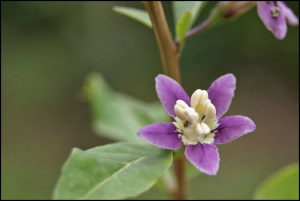
Wolfberry (Lycium barbarum) is a deciduous shrub in the Solanaceae family with arching branches that can reach 10 feet in height. It produces small, oval red fruits that are harvested for food and medicine. The plant is native to China, which is where most of the world’s supply of wolfberry is grown, mainly in the Ningxia Hui Autonomous Region and the Xinjiang Uygur Autonomous Region (Engels and Brinckmann, 2017). In Chinese, the name of the plant is gouqi (枸杞) and the fruit is gouqizi (枸杞子). The character for gou is related to the one that means “dog” or “wolf,”, hence the common name wolfberry. In the U.S. the fruit is commonly called goji berry, from the Americanized pronunciation of gouqi (Dharmananda, 2007; Engels and Brinckmann, 2017). In the early 2000s a product branded as “Himalayan Goji Juice” became popular in the United States as a “super food;” however, “the term ‘Himalayan goji’ is only for marketing purposes and is not an actual geographical indication” for the source of the fruit (Engels and Brinckmann, 2017).
 Lycium first appears in the written record in a book of poems from the Zhou Dynasty (1100s – 300s B.C.E.), called the Book of Songs, in which harvesting of the fruits was described. Medicinal use was first recorded in the Shannon Bencao Jing, an herbal from the 1st century C.E. In Traditional Chinese Medicine it is used to nourish the kidney and liver, moisten the lungs, enrich the blood, and improve vision. Modern research supports wolfberry consumption for aiding vision. The fruits contain high levels of zeaxanthin and lutein, carotenoids that are absorbed into the retinal macula lutea. The antioxidant activity of these compounds can help protect against macular degeneration (Dharmananda, 2007; Engels and Brinckmann, 2017). Wolfberries are also used in cases of diabetes, for dizziness, and as a “longevity aid” (Dharmananda, 2007; Yao, Heinrich, and Weckerle, 2018).
 Its use as a longevity aid likely led to a couple of folk tales about the fruit. In one, a traveling scholar comes upon a girl/young woman beating an elderly man. The scholar thought it terrible that the girl was disrespecting her elder in such a way and confronted her. The girl replied that the man was her great-great-grandson, and she was punishing him for not eating his wolfberries to stay young. Another tale tells of a town (or in some stories, a group of monks) full of centenarians. The story goes that all the citizens drank from a common well around which wolfberry plants grew, dropping their fruits into the water and thereby infusing the water with healthful, life-extending properties.
Wolfberries are also consumed in China as a food. They’re cooked into rice congee and soups, brewed into tea, and blended with grapes into wine (Wolfberry, 1997-2021). Despite the long history of wolfberries as a safe food, their position in the Solanaceae family prompted researchers to investigate their chemical constituents. Might this plant contain such dangerous alkaloids as atropine, hyoscyamine, and scopolamine, like its deadly cousins? Although an initial study suggested low levels of atropine are present in the fruit, these results were later called into question, as the fruits tested may have been from species other than L. barbarum (Qian, Zhao, Yang, and Huan, 2017). Further investigation with properly identified cultivars of L. barbarum concluded that no toxic alkaloids are present and wolfberries are safe to eat (Kokotkiewicz, Migas, Stefanowicz, Luczkiewicz, and Krauze-Baranowska, 2017).