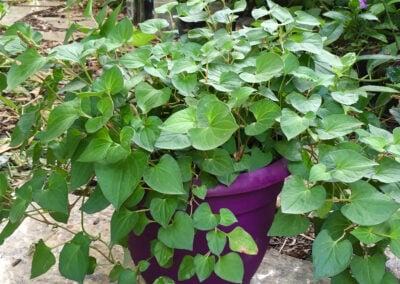
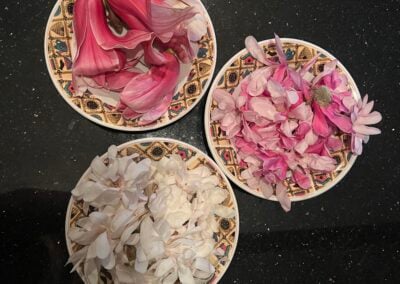
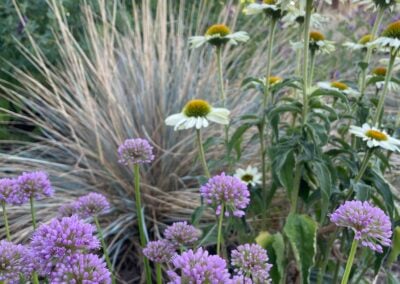
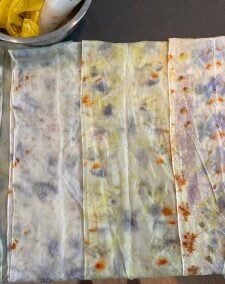
I was recently putting together tabletop floral arrangements for the Western Reserve Herb Society’s October Unit Meeting. I threw together a selection of yard flowers and peppers that were just maturing. The pretty filler in the arrangement came from a perennial that I had planted in the spring, under the impression it was Joe Pye weed. When it started blooming in the early fall it was clear that I was mistaken. It looked like this:
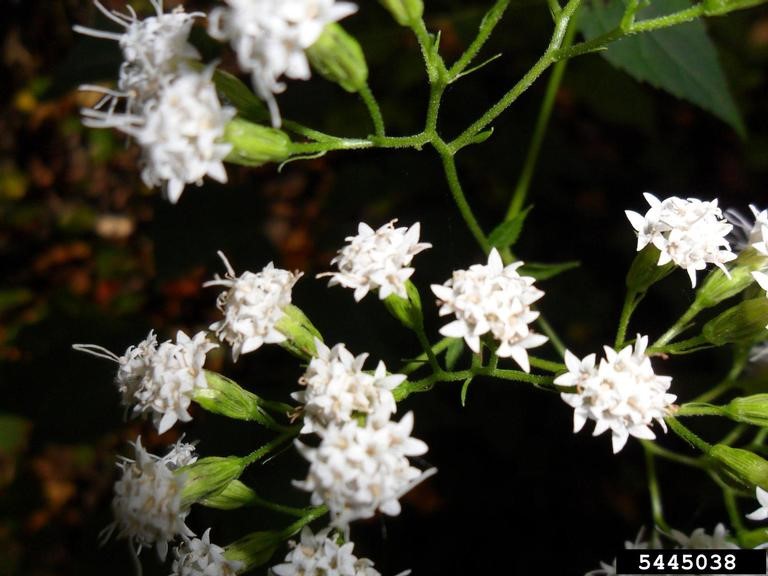
Pretty, right?
When I was asked to identify the mystery flower at the meeting, my lame observation that I thought it was Joe Pye Weed met with the pitying scorn it deserved. So I looked it up to redeem myself, and the answer is much more interesting, menacing and even twisted. It’s no innocent, pearly everlasting.
This was Ageratina altissima, also known as White Snakeroot, Richweed, White Sanicle, Tall Boneset, and (I must point out) White Joe Pye Weed.
White snake root is fairly bursting with the toxin tremetol. It is native to the American Midwest and upper South. And when the first Europeans brought livestock to the area, the combination was lethal. The animals would, after eating the leaves or stems of the White Snake Root plant, develop “the trembles,” which is pretty much what it sounds like. But worse.
If people drank milk from a cow suffering from the trembles, the result was seizures, vomiting and death. The link between affected cows and milk was easy enough to trace, and the disorder was commonly known as Milk Sickness. Abraham Lincoln’s mother, Nancy Hanks, died from Milk Sickness in 1818, and so did many, particularly in the Ohio Valley.
But to establish the link with White Snake Root took a more subtle mind. And here we encounter a woman that I think we should hear more about, Dr. Anna Pierce Hobbs Bixby. In the 1830’s Dr. Bixby heard from an unidentified Shawnee woman about the toxic nature of White Snake Root. Once the link was established, farmers began to eradicate White Snake Root. Although, apparently, you can still buy it at garden centers as a perennial that does well in damp areas with indifferent light.
And a preparation from the root is traditionally held to be an antidote to snake bite. So, there’s that.