Like most murder mysteries, those with horticultural themes call for a minimum of one sleuth. Criminal investigation, whether vocation or avocation, calls for many of the same skills as horticulture. A gardener, like a detective, needs to be observant and thorough. Three of my favorite gardening investigators are Miss Jane Marple, Brother Cadfael, and China Bayles.
 Agatha Christie launched her character Jane Marple in a series of short stories published at the end of 1927. Miss Marple gardens intensively around her cottage in the fictional village of St. Mary Mead. She prefers flowers to vegetables, but makes room for useful plants among the perennials.
Over the course of the Miss Marple mysteries, Jane offers her visitors a variety of home-brewed garden tonics. A soporific infusion of chamomile soothes restless guests. Tansy is a key ingredient in her grandmother’s herbal tea. She steeps macerated plums in sugar and alcohol for her special damson gin. Primula veris, the basis for her cowslip wine, blooms wild in the fields and meadows around the village. That is fortunate, as every batch would have needed several pecks of bloom.
Eight centuries before Miss Marple, another gardener-sleuth in the British Isles tended a fictional herb garden. Brother Cadfael is a creation of Ellis Peters, one of several noms de plume of British author Edith Pargeter, who penned dozens of novels between the ‘30s and the ‘90s, with twenty of them featuring her well known detective of the cloth. Cadfael is an early 12th century Welsh monk of the Benedictine Abbey of Saint Peter and Saint Paul in Shrewsbury. Of middle years, Cadfael was blessed with a late vocation after wide experience with warfare, women, and life in general.
 As the Abbey’s herbalist, Brother Cadfael is most often busy in the herb garden or in the adjacent workshop for drying, storing, and extracting essences from the harvest. He is a skilled gardener, curious in the old Latin sense of the word, as in cura for “care” and curiosus for “careful.” The equivalent of today’s pharmacist, he takes pains over plants and people, making tinctures, salves, and syrups. And he solves many crimes.
While Ellis Peters did not tend her own herb garden – she once told an interviewer from Mother Earth Living that the plants in her garden that would qualify as herbs were limited to a few kitchen standbys like rosemary – she was a meticulous researcher. She relied on an old English herbal for her background research. “I draw a great deal on Culpeper,” she said in a 1993 interview. “He’s a much later period, of course, but his information is sound.” Nicholas Culpeper was a seventeenth-century London physician, a profession which, at the time, combined doctor, apothecary, astrologist, and, in his case, renegade. A careful read of the Cadfael series is an entertaining, informative introduction to the plantings and practices of a medieval herb garden.
 For a more recent take on the herb gardener-detective, might I suggest Susan Wittig Albert’s savvy, long-running series featuring protagonist China Bayles. In the first book, Thyme of Death (1992), Bayles has walked away from a high-pressure job as a big-city criminal defense attorney and remade herself. Having relocated from Houston to the fictional county seat of Pecan Springs, she is now the proud proprietor of Thyme and Seasons, a business selling herbs for all reasons: fresh, dried, potted, and potions. Unfortunately, like St. Mary Mead and twelfth-century Shrewsbury, the rural town of Pecans Springs has more than its share of homicides.
Each of the twenty-one China Bayles mysteries spotlights one plant species. If you pick up Rueful Death, for example, you can be assured that rue will be woven artfully through the plot, and that you will learn a great deal about its history, cultivation, and uses as the action unfolds.
Beyond detectives like this trio, horticulture has made frequent appearances in crime fiction. Why? Perhaps it is due to the gardener’s natural malice towards weeds, rodents, and other garden undesirables. Rare is the gardener who can approach a slug without homicidal intent. Or perhaps it is the natural chaos waiting to take over any cultivated place. Let’s face it, gardening can be murder.
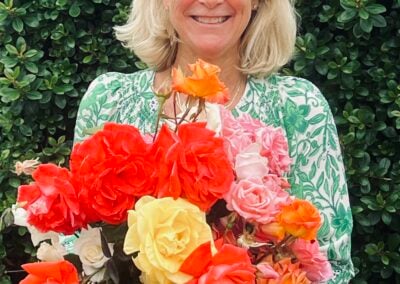
Join Marta on Tuesday, November 14 at 1pm Eastern for the webinar: Herb Gardening Can Be Murder! Our webinars are free to The Herb Society of America members and $7.50 for guests. Become a member today, and enjoy all of our webinars for free along with access to the webinar library with over fifty program titles. To register, visit https://www.herbsociety.org/hsa-learn/herb-education/hsa-webinars/