Horseradish—A Root With Bite
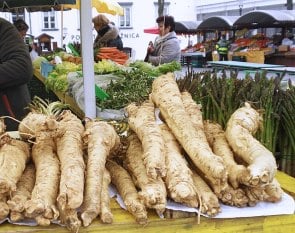 Few plants can evoke such a range of emotions as horseradish (Armoracia rusticana), which can make you laugh, cry, and clear your sinuses all at once. Horseradish is an herb famous for its very pungent root. It is a cousin in the mustard family (Brassicaceae), along with cabbage, kale, and Brussels sprouts. It has been cultivated as both a medicinal and a culinary plant for at least 3,000 years.
A Storied Past
Horseradish has its roots in Eastern Europe (literally and figuratively) and was initially used to treat respiratory and digestive ailments, as well as a poultice for back pain.
The Greeks used horseradish as both a medicinal and an aphrodisiac. Legend tells us that the Oracle of Delphi declared: “The radish is worth its weight in lead, the beet its weight in silver, and the horseradish its weight in gold” (Horseradish.org, n.d.).
Romans used the herb as a remedy for coughs and colds, as well as an antidote for poison. They also used it as a condiment for meat.
 Even its name comes with a twist of history. In German, it was called meerrettich—”sea radish.” However, when the English adopted it, they misheard “meer” as “mare” and turned it into “horseradish.” The name stuck, despite the plant having no connection to horses (Herb Society of America, 2010).
By the Renaissance period, horseradish was used across Europe. It became the standard condiment for meat and oysters in England in the 1600s. The first printed use of the word “horse radish” was by the English botanist John Gerard in his book Herball, published in 1597.
European immigrants carried the herb to North America in the 19th century. It was cultivated in the Midwest, a region with soil suitable for its growth. In fact, the Midwest city of Collinsville, IL, calls itself the international “Horseradish Capital of the World.” Each June, the community celebrates with an International Horseradish Festival, where visitors can grind their own roots—or even join a horseradish tossing contest. Today, 60-80% of horseradish is grown in Southern Illinois due to the unique soil conditions there (Saint Louis Magazine, 2018).
On the Table and in the Medicine Chest
Grated horseradish root is what gives Bloody Marys, seafood cocktail sauce, and roast beef sandwiches their characteristic bite. In many Eastern European homes, it is mixed with beets and served at Easter alongside ham, sausage, and eggs. It even plays a role in Jewish Passover Seders, symbolizing the bitterness of slavery in Egypt.
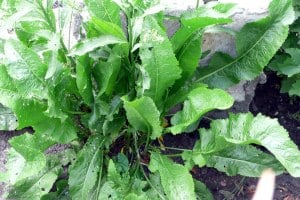 The young leaves of the plant can be eaten as a vegetable or tossed into a salad. The grated root can be added to vegetable casseroles or spread on meats before roasting. Here’s a tip from herbalist Susan Belsinger: “When cooked, horseradish root changes from hot to rather earthy, sweet, and nutty, although a slight pungency remains.” The pungency of the root comes from the mustard oils released from the damaged plant cells when the root is cut or grated (Herb Society of America, 2010). Adding vinegar stops the chemical reaction (Welliver, 2023).
John Henry Heinz bottled the first commercial horseradish sauce in 1869 using his mother’s recipe. It was one of the first condiments sold in the United States (Herb Society of America, 2010).
Beyond the kitchen, horseradish boasts a long medicinal history. Modern studies confirm what ancient healers suspected: horseradish contains compounds like sinigrin that fight inflammation and may help prevent cancer. Other natural chemicals combat bacteria and fungi. Its spiciness also promotes mucus production, allowing the body to flush out respiratory infections. That said, people with inflammatory bowel conditions should use caution—sometimes the cure can be a little too fiery (Cleveland Clinic, 2024).
Grow Your Own
 Horseradish is a hardy perennial plant in USDA Zones 2-9. It requires sun or partial shade and well-drained, loamy soil. The plant or root cuttings are planted in the spring or fall. It should be allowed to grow for one year before harvesting the root. The plant can become aggressive, however. The root is harvested in the fall. The washed and dried root can be stored in the refrigerator for three months. It is recommended that the root be grated in a well-ventilated area, as the pungent fumes released can irritate the eyes and nose.
And Finally
Horseradish has a long, colorful story: from ancient Greek legends and Roman medicine to Renaissance feasts and Midwest festivals, horseradish has traveled the world, leaving a sharp impression wherever it goes.