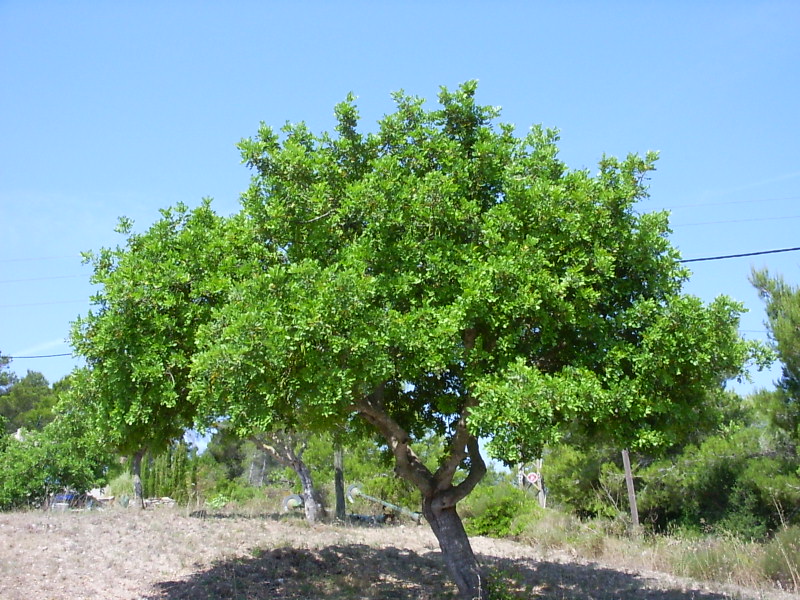
 Have you heard of St. John’sbread or locust bean? These are all names for the carob tree,
Ceratonia siliqua
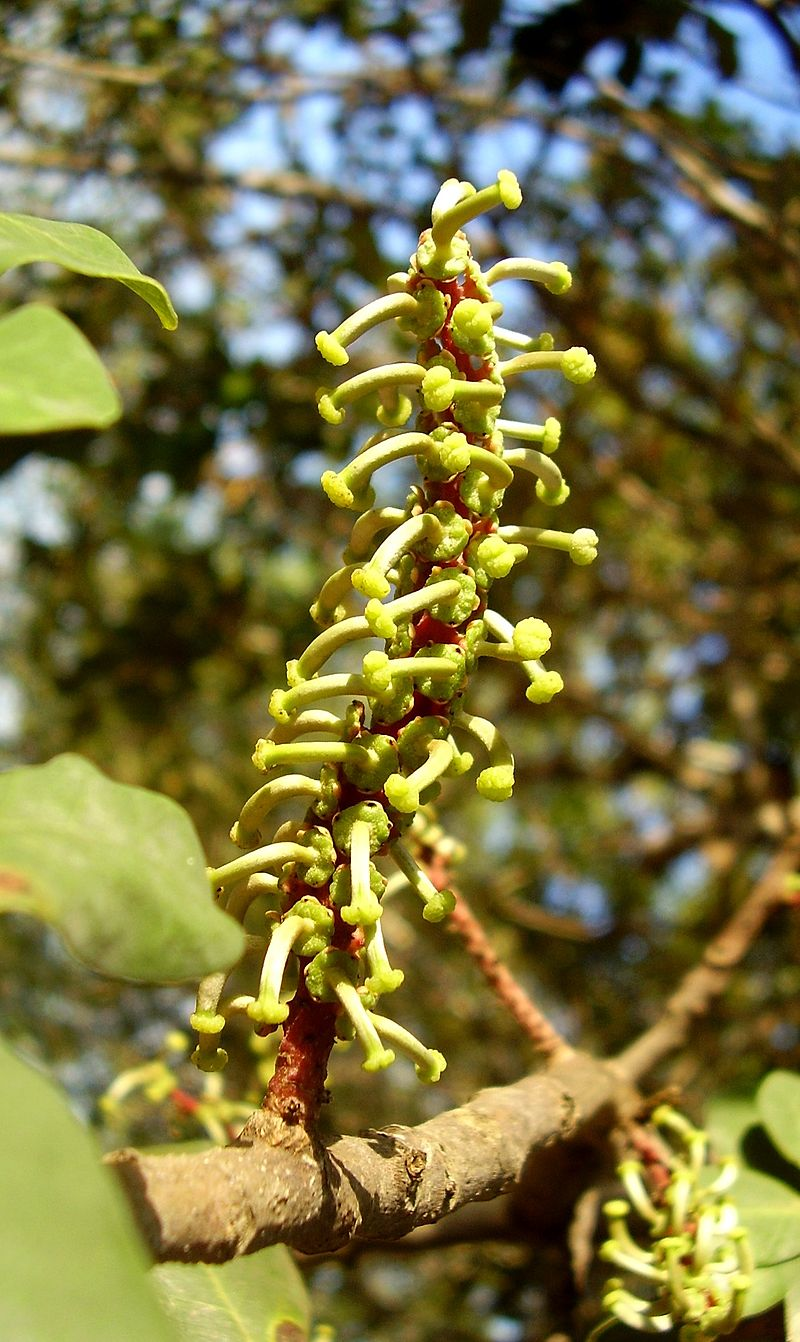
Carob is a multi-stemmed, evergreen tree that can reach 50 feet high and 50 feet wide, and its broad, dark green leaves make it a good shade tree. It is mostly a dioecious tree, meaning that there are separate male and female trees. The flowers grow from the old, woody bark along the branches. Only the female trees produce fruit, starting when the tree reaches 8 years of age; however, fruit for commercial production begins when the tree is 20 years old. A mature tree can produce up to a ton of fruit in one season. The fruit is a sword-shaped pod that can grow to 12 inches long. When the pod turns from green to brown, it is ground into a powder and roasted. The result is used as a substitute for cocoa powder and flour. The seeds are a bit larger than watermelon seeds and are used to make locust bean gum, a food additive that thickens and stabilizes foods like ice cream and salad dressings.

History
The carob tree has a 4,000-year history of use. Some say that the tree is a survivor from a now-extinct group of the Fabaceae family (Loullis, 2018). Because carob seeds are fairly uniform in weight, ancient jewelers used the seeds for weighing gems and gold. One carob seed was the smallest weight for a diamond, giving the name “carat” to the measurement. Egyptians used carob to bind the wrappings of mummies and used it to make beer. They also treated wounds and eye conditions with it.
There are several biblical references to the use of carob. Its name, “St. John’s bread,” refers to St. John the Baptist being sustained in the desert by eating “locusts and wild honey” (Mark 1:6 and Matthew 3:4). Locusts were mistakenly (some say) thought to be carob pods (Gardner, 2012). It was nutritious and easy to digest, and so porridge was made from it and fed to the elderly. Because there was so much available and could be easily stored, it was a significant part of the diet of poor people during biblical times.
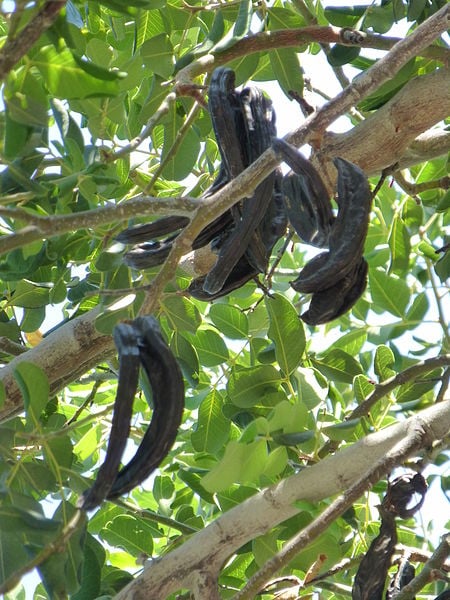 Carob pods discovered in the storehouses of Pompeii show that the Romans were harvesting the tree as early as 79AD. The Romans ate the carob seeds for their sweetness. The Greeks used carob pods as fodder for their pigs and food for their people.
In 1854, the U.S. Patent Office imported 8,000 carob trees from Spain and sent most of them to California. A profitable crop was not able to be produced from the trees so they were used for landscaping instead. In a prescient statement in 1914, Santa Barbara Agricultural Commissioner, C.W. Beers, commented that “The day may come when the deserts will be extensive forests of carob trees” (Kauffman, 2018).
The carob tree has been a source of nutrition during times of war and famine when supply chains of basic ingredients were interrupted. It was a lifesaver for many during the Spanish Civil War. It was the “chocolate of occupation” during WWII and was used as a substitute for flour and coffee. It has been considered to be the food of the poor, and was food for domestic animals. At one time, singers chewed the pods believing that it cleared the throat and voice.
Current Uses
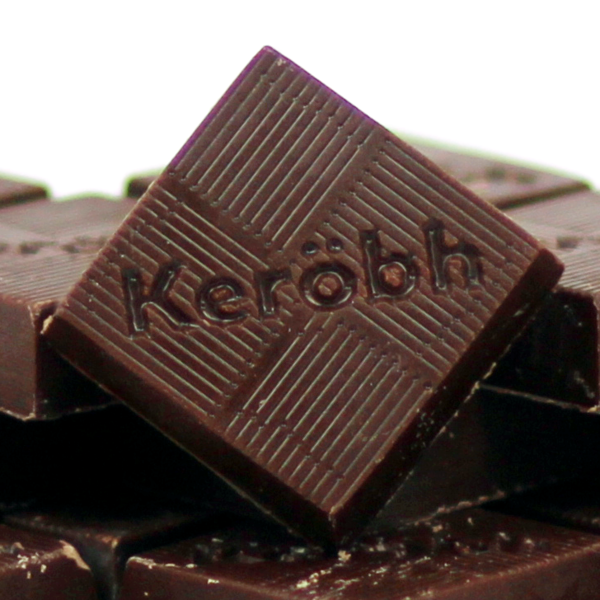
Even today, carob has an amazing number of uses—from medicines, food for humans and animals, photographic film emulsions, adhesives, paints, inks, and polishes, and even cosmetics. Its wood is prized by wood craftsmen and also makes good charcoal. Italians use the seeds for rosary beads. The nutrients in carob have made it a health food staple, as it is high in fiber and natural sugars and is also a low-fat, no caffeine substitute for chocolate. Medicinally it’s used as both an anti-diarrheal and a mild laxative.
 Recent research shows that carob powder is a rich source of the antidiabetic compound D-pinitol, a type of sugar. D-pinitol can decrease blood sugar levels and prevent obesity by suppressing the increase in human adipose tissue. In addition, the polyphenols in carob fiber have been shown to inhibit cell proliferation in some cancers (Loullis, 2018).
My favorite story about carob comes from the Babylonian Talmud (Tractate Ta’anit 23a):
One day, Honi the Wise Man was walking along the road and saw a man planting a carob tree. Honi asked the man, ‘How long will it take for this tree to bear fruit?’ The man answered, ‘Seventy years.’ Honi replied, ‘And do you think you will live another seventy years and eat the fruit of this tree?’ The man answered, ‘Perhaps not. However, when I was born into this world, I found many carob trees planted by my father and grandfather. Just as they planted trees for me, I am planting trees for my children and grandchildren so they will be able to eat the fruit of these trees (Vamosh, n.d.).
Carob is The Herb Society of America’s Herb of the Month for November. More information about the tree along with recipes and a beautiful screensaver can be found at https://www.herbsociety.org/hsa-learn/herb-of-the-month.html