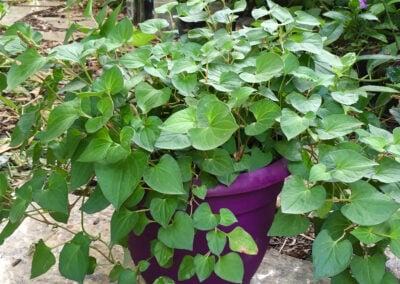
Holy Basil or Tulasi (also spelled Thulasi) Ocimum tenuiflorum is a sacred and revered plant in the Vaishnava tradition of Hinduism. It is considered an elixir of life. Tulasi means “the incomparable one” in original Sanskrit. The petals are mixed with water and given to those who are dying to raise their departing souls to Heaven.
Holy Basil is not to be confused with Thai basil or Thai lemon basil which are two entirely different herbs. Holy basil has an astringent taste and strong aroma and may not be pleasing to all.
This plant is native to the Indian subcontinent and has spread throughout Southeast Asia. It is a shrub which grows to about 12 to 24 inches tall. The “slightly toothed” green and purple leaves are attached to “hairy” stems and have a very strong scent. Tulasi is grown for religious and medicinal purposes and for its essential oil.
It is common practice for Hindu families to grow Holy Basil at their homes. It is traditionally planted in the center section of the central courtyard very near the house.
Puranas are Sanskrit sacred writings of the Vaishnavas, (in Hinduism-the followers of a sect of Hinduism who consider the god Vishnu as “Supreme Lord”). Vaishnavas believe that Dhanvantari, the avatar (descent of a deity, in this instance Vishnu, to Earth in earthly form) comes up from the ocean. When he does he is holding Amorita (nectar, which literally means immortality) for the gods. Dhanvantari sheds happy tears and when they drop on Amrita, Tulasi is formed.
Holy Basil is also worshipped in other sects of Hinduism. Tulasi is also frequently grown near Hanuman temples which are magical temples of the god Hanuman found all throughout India.
The herb is used in ayurvedic medicine as a remedy for many ailments. Essential oil from Tulasi is used generally medicinally. The herb is taken in many ways such as herbal tea, mixed with ghee, dried powder or green leaf. It is also used for herbal cosmetics. The dry leaves have been mixed with grains for centuries to repel insects. This herb is used as a mosquito repellent in Sri Lanka.
In Thai cuisine the leaves of Holy Basil or kaphrao, as it is called in the Thai language, are used in some Thai dishes. The most famous of these is phat kaphrao. This dish is a stir fry of meats or seafood and the leaves. It becomes khao phat kaphrao if rice is added.