When most people hear the word “herb” today, they think of flavorful additions to cooking or natural medicines. In ancient Greece, herbs were both of those things and much more. Herbs had fabulous origin stories, magical properties, and were valued by mortals and immortals alike.
Mugwort (Artemisia vulgaris)
Mugwort was named after Artemis, twin sister of Apollo (god of light, music, and medicine). It wasn’t unusual for a god to have multiple responsibilities. Artemis was best known for being the virgin goddess of the hunt, but she also protected women through pregnancy and childbirth. Some scholars believe the Artemisia festivals were originally springtime fertility celebrations held during a full moon. Participants ingested mugwort, which symbolized consuming the goddess (Albert-Puleo, 1978; Ratsch, 2005).
 Ancient Greeks used mugwort to treat gynecological issues in several ways. When smoked, mugwort foliage was used as a relaxant to ease the pain of childbirth. And recent studies show that extracts of mugwort leaves can regulate the menstrual cycle and have a strong anti-implantation effect, confirming it was effective birth control (Ekiert et al., 2020).
Artemis had no sympathy for anyone who breached her rules of modesty and chastity. When Actaeon, a hunter, accidently stumbled upon Artemis bathing, she punished him by turning him into a deer. His own hunting dogs then tore him to pieces (Callimachus). But when it came to women experiencing the pain of childbirth, Artemis was not cruel. She offered them assistance in the form of her namesake herb.
Parsley (Petroselinum crispum) & Celery (Apium graveolens)
In the Peloponnesian city of Nemea the royal family celebrated the birth of their son Opheltes by asking the oracle at Delphi for a prophesy about his life. The oracle declared that Opheltes would lead a long and happy life, if he didn’t touch the ground before he learned to walk. Sounds simple, right?
 Apparently Hypsipyle, Opheltes’s nurse, didn’t get the memo, because one day as she cared for the prince, she stopped to talk with a group of soldiers passing by. She told them her sad tale of unwed motherhood and life as a slave, and as they chatted, Hypsipyle set Opheltes down on a bed of celery.
No one noticed the nearby serpent, who bit Opheltes, killing him. The herb parsley grew from his blood. Funeral games were held in Opheltes’s honor and became the Nemean Games (Apollodorus), which, like the Olympics, drew competitors from all over Greece. Winners were crowned with a wreath of celery.
Rue (Ruta graveolens)
Ancient Greece was considerably larger than modern Greece is today. It included parts of North Africa, land around the Black Sea, and parts of the Middle East. Pontus (in modern day Turkey) was ruled by King Mithridates who was a fierce and ruthless warrior. Yet, he was terrified of being poisoned. So King Mithridates created what he believed was a universal antidote. The recipe was discovered after Mithridates’s death, and the primary ingredient was the herb rue (Pliny the Elder).
 Equally interesting (and unlikely) is the story of how Medea used rue to keep her husband Jason away from the ladies. After helping Jason steal the Golden Fleece, Medea and Jason sailed back to Greece. En route, they passed the island of Lemnos. Medea knew that Jason had dallied with the princess of Lemnos on his outbound voyage. This was before he met Medea, but Medea was the jealous type. She tossed rue into the water surrounding the island, and the story tells us that when the women of Lemnos swam in the rue-infused water it made them smell so bad that no man would approach them (Detienne, 1994).
While this is highly unlikely, rue did have a role to play in ancient Greek birth control.
Rue can prevent implantation of the embryo and was a well-known abortifacient. Today we know it can cause infertility in some male mammals (Abebe, 2021). Perhaps Medea was onto something.
Tansy (Tanacetum vulgare)
Ganymede was the son of Tros, founder of the city of Troy. He was said to be the most beautiful of mortals (according to Homer), and Zeus fell in love with him. One day, Zeus either sent an eagle down to capture the boy or transformed himself into an eagle to do the kidnapping. Ganymede was brought back to Mount Olympus and made cup-bearer to Zeus. He may also have provided other personal services.
 In compensation, Zeus gave Ganymede’s father a pair of the same immortal horses that the gods themselves rode. To Ganymede, Zeus gave a drink of tansy, which made the boy immortal. Despite its history as a medicinal herb, today tansy is considered toxic in some forms. The essential oils of tansy contain thujone, which is toxic to humans in high doses (Georgescu et al., 2014). But water-based extractions have been used safely by herbalists for millennia. So what did Ganymede drink, exactly? Did he have to die, giving up his mortal form, before he could become immortal? Today Ganymede lives on as the constellation Aquarius, the water-bearer (Hyginus).
Many ancient Greek remedies sound ridiculous to the modern reader, yet despite the fact that they had no modern laboratories or equipment, the ancient Greeks devised some effective remedies that herbalists still use today. You’ll learn more about plants essential to Greek myths in Mythic Plants: Potions and Poisons from the Gardens of the Gods.
Ellen Zachos will be presenting Mythic Plants: Herbs and Spices in Ancient Greece at The Herb Society of America’s Educational Conference, taking place in San Antonio,Texas from April 15-17, 2026. Become a member to take advantage of early bird pricing from now until February 1, when registration opens to the general public at full price. You can find the full agenda and registration details here.
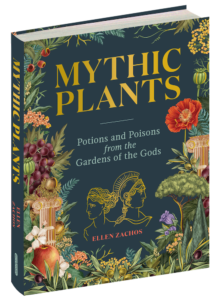 Ellen Zachos is a Harvard graduate and the author of eleven books including