In early July I was invited to a potluck picnic for Edible Cleveland magazine. Potlucks push my overachiever button and I wanted to impress my fellow writers. So, I challenged myself to making something apropos of the magazine — local, seasonal and organic. As the blogmaster for The Herb Society of America I thought it would be fun to reflect my passion for herbs.
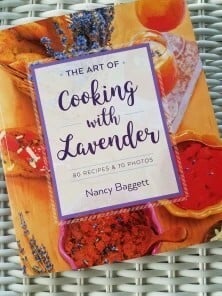 Lavender scones seemed like a great idea, but they just weren’t impressive enough. So, I picked up The Art of Cooking with Lavender by Nancy Baggett. There I found a recipe for lavender chicken salad.
(The boyfriend said he’d chose Wendy’s over lavender-spiked food, but he ate the chicken salad without notice.)
My next step was to gather significant ingredients … free-range, organic chicken from New Creation Farm in Chardon, Ohio, and lavender from Luvin’ Lavender in Madison, Ohio. That’s where I learned that not all lavender is created equal when it comes to the kitchen.
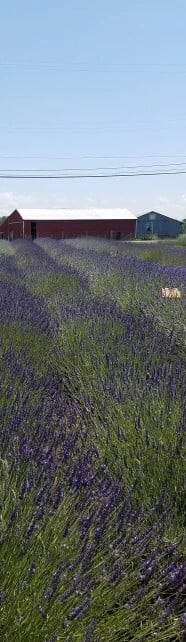 Luvin’ Lavender grows 19 varieties, with a seven best suited to culinary use. That’s because each variety has subtle (or even bold) taste differences. Some are sweeter or more floral; others have a stronger camphor component.
Having learned from the owner Laurie H, I turned to my friend Edgar Anderson of Fragrant Isle Lavender Farm, Shop & Le Petit Bistro on Washington Island in Door County, Wisconsin, with more questions on lavender in the kitchen. Anderson and his wife Martine operate a 21-acre farm with 14,000 plants – 10 varieties — on five acres of land. In addition to their Washington Island retail shop, they operate another retail shop in Fish Creek, WI and a bistro with a lavender-based menu.
“For cooking, it’s best to stay within the English varieties – Lavendula angustifolia,” he says. The most commonly found L. angustifolias as retail are ‘Hidcote’, ‘Munstead’ and ‘Royal Velvet’.
“Within the English there are minute nuances. They’re usually very sweet in taste and smell. One might be more lemony or flowery, but all are easy to work with in the kitchen,” says Edgar. Fragrant Isle uses royal velvet in most of their edible products.
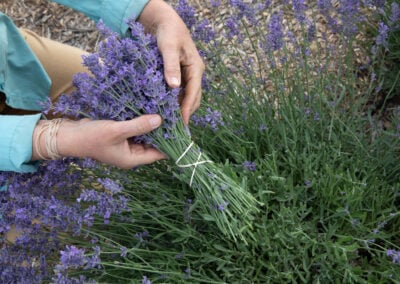
English lavender is usually harvested from June through July. Fragrant Isle harvests twice, once for buds and once for distilling into oil. Harvesting for dry buds – unopened flowers – is done by hand. Flower stems are cut and made into small bundles tied with rubberbands.
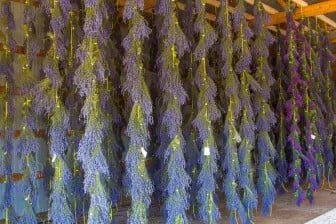 The bundles hang in a barn for six weeks until they’re dry enough to separate purple flower buds from gray-green stems. While the farm mechanizes separation, home growers can gently shake or brush the crop into a bag or onto a cloth.
Leaves, stems and debris should not be part of the process . “You don’t want them because they will give a grassy scent to your cooking. We have vibrating sifting screens to remove debris. They go through three different screenings.” At home colanders and mesh sifters might be useful.
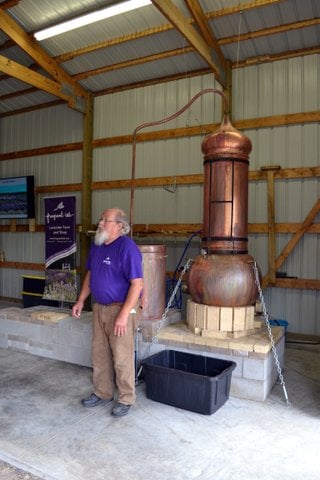 The culinary lavender oil is distilled from fresh lavender bundles. The fresh lavender bundles are placed in their copper still, usually 40 pounds of fresh lavender bundles, and once the water reaches 212 degrees F, the lavender is “cooked” for 90 minutes. Then the lavender flowers release their essential oil and hydrosol, which are captured in a glass container. The essential oil, being lighter than water floats to the top. Once the hydrosol is drained, the essential oil remains and is placed in a glass bottle. Culinary essential oil is used for baking, as it is more potent than culinary lavender buds.
Once processed Fragrant Isle either uses the lavender in the bistro or packages it for sale. Home growers should put it in a sealed container – preferably glass — and store away from humidity.
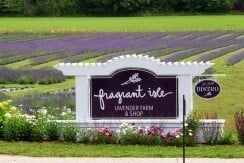 Fragrant Isle Lavender Farm & Shop, is hosting its 3rd Annual “All Things Lavender” Festival Friday, July 21 – Sunday, July 23, 2017. Festival highlights include daily seminars presented by Lavender Industry Experts, Experiences to explore one’s inner artist with painting classes, pampering with massages, Destiny Readings, Lavender U-Pick Field, Entertainment by Musical performers & Washington Island Scandinavian Folk Dancers and Food be it a taste of “lavender,” from sweet to savory, exquisite chocolates, Apple Lavender Cider, or Light Belgian style beer with bright lavender and honey tones.