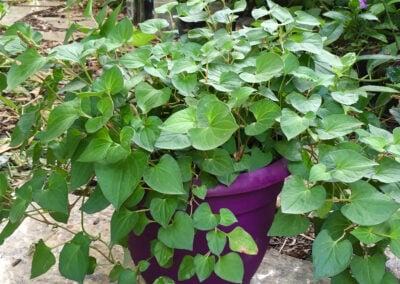
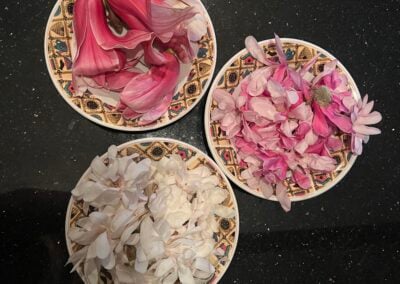
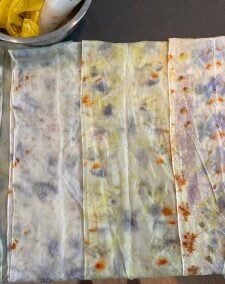
Author Chris McLaughlin shows readers how to use botanicals to dye fiber and fabric in her book A Garden to Dye For (St. Lynn’s Press, 2014, $17.95). Her palette includes the obvious and the obscure. Indigo and madder root are well documented. But, did you know the properties of pokeberry, mint, bee balm, purple basil, marjoram, tansy? Check out Chris’s book and learn to coax color from nature.
The book itself is small enough to tuck into a purse for reading on long journeys or in busy waiting rooms. And, it’s full of garden layouts and step-by-step instructions illustrated by lush pictures.
We recently caught up with Chris for an interview about her all-natural, organic options for dying fiber and fabric.
 How did you get interested in using plants for dye?
As a lifetime gardener I was aware that some plants could be used as natural dyes, but for years the only project I had ever used them for was Easter Eggs. Once I become involved with hand-spinning fiber, I rediscovered botanical dyes — this time using natural fibers such as mohair, silk, and cotton.
How do you use dyeing in your life?
I mostly use botanicals to dye the yarns that I handspin. One of my favorite uses is to make artisan silk scarves and play silks for young children.
What’s your favorite color? Your favorite herb?
I don’t truly have a favorite color nor herb. However, it’s really exciting to watch the purples come out of the lichen dye pot. Also marigolds are usually within reach for almost everybody and so easy to use. That’s my go-to much of the time. I was surprised to find how much I love the walnut dye. It’s the richest brown ever.
What results have you had?
My results are often consistent with what I set out to achieve. However, if they are not, then I consider it a learning moment. I also experiment with botanical materials collected at different times of the years to see what results come from them. I’ve never had so much fun with experimentation.
Will people fail and move on? Can they fix things?
If you’re trying to achieve a specific color and it turns out differently than you’ve heard it “should” then you might have to adjust the pH of the bath by adding something alkaline such as baking soda or acidic such as vinegar. So, in that sense, it can be fixed it altered.
If I have dyed something already and can’t alter the dyebath, then I simply make a new one or dye over it.
What should everyone remember to do?
Have patience. Many times people assume that their dyebath has failed” to produce a certain color. When the truth us that if they have more patience and slow down, it often shows up.
What pointers/tips would you offer dyers?
The best piece of advice I can offer is to try dyeing with several plant materials and various textiles. I find that cotton has the hardest time taking natural dyes and that can be discouraging if that is the first (and only) thing that you try dyeing. If you want results immediately, go for wool or silk the first time around.
Also, if you are getting various natural dye “recipes” — try all of them. See what works for you and what you enjoy best. And don’t forget to write everything down! You think you’ll remember what you used to achieve a certain color…but you honestly won’t.