 I have nothing against the Druids. But it must be said that (apart from the practice knocking on wood for good luck) they have contributed little to our way of doing things. Christmas is the exception. Holly and ivy and Christmas trees are all Druidic legacy.
Another persistent and peculiar Druidic Solstice custom involves the fertility magic conferred by the ironically parasitic plant mistletoe.
More than 1,000 varieties of mistletoe exist around the world. Among their many names are birdlime, all-heal, golden bough, drudenfuss, iscador and devil’s fuge. All are plant parasites. The European mistletoe, Viscum alba, is most commonly found on apple trees, poplars, willows, lindens, and hawthorns. North America’s oak mistletoe finds its hosts among a host of deciduous trees, and is named Phoradendron, Greek for “tree thief.”
The growth of mistletoe is slow, but persistent. Once established on a tree mistletoe will syphon nutrients from the host plant. It returns nothing. In fact, mistletoe will sometimes give up its own photosynthesis and drain the life from its host. It may produce its own branches and leaves, growing from the host plant’s stem or trunk.
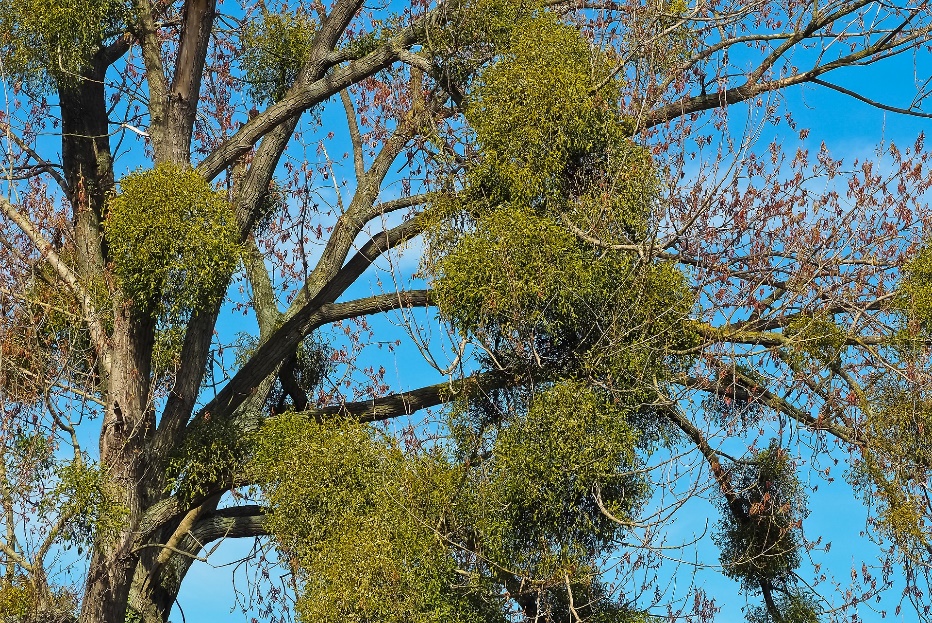
Once a host tree loses leaves in fall, mistletoe — which produces a “witch’s broom” tangle of evergreen foliage — is clearly visible. In the deep midwinter, this green makes mistletoe a star.
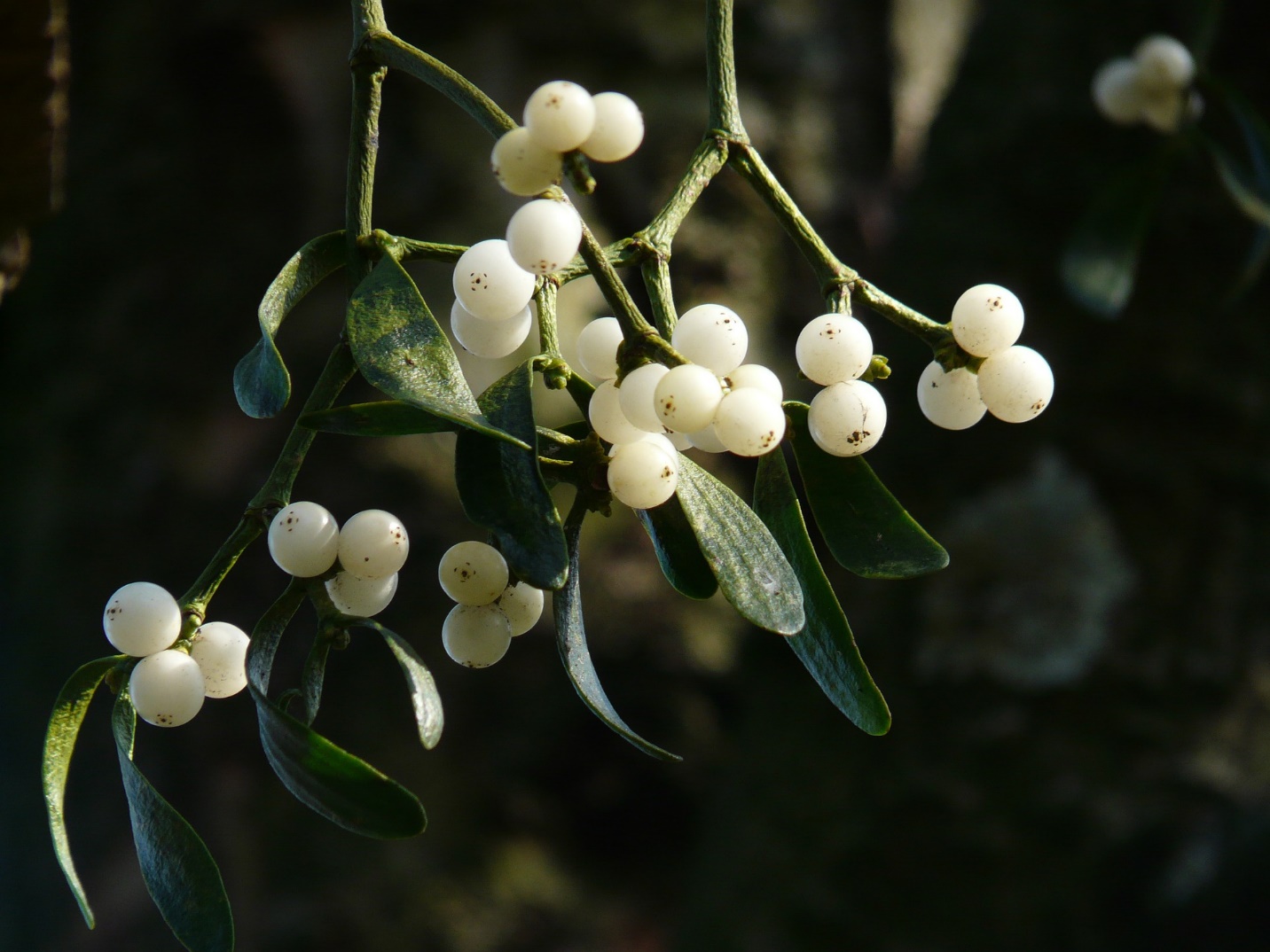
 When happily in position, mistletoe can propagate itself. It produces flowers, and later waxy white drupes or berries. Those berries are beloved by birds. The berries are filled with a thick, sticky gel, cradling the seeds of the mistletoe. Birds’ beaks are sticky after eating the berries. As the bird cleans its beak by raking it against the bark of a tree, seeds from mistletoe are deposited into the new scratches and begin to grow. Or mistletoe seeds may find a new home after passing through the bird’s digestive track.
Tasty to birds, the berries are highly toxic to humans. That’s one reason why “mistletoe” sprigs at stores will be genuine plastic. The old custom of kissing under the mistletoe requires removing a berry for each kiss, and a loss of the plant’s powers after the plucking of the last berry. But I have found that magic lies in intention, not technicalities.
Modern study suggests that the mistletoe, while needy and controlling, is not a bad neighbor. Woodlands containing mistletoes are hospitable to birds, animals and insects, probably because of the housing made available in the dead or dying host plants. This makes it an ecological “keystone” species. There is promising research underway using mistletoe to derive treatments for cancer in humans.