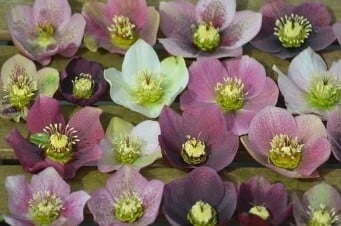
 In the language of flowers, hellebore means, “calumny (false accusation) slander.” The name, hellebore, is derived from the Greek ἑλεῖν (heleîn), meaning “to injure.” In French, hellebore is called “Herbe aux Fous”, which I think means something like “crazy plant.”
What on earth did hellebore do to deserve this? Maybe it’s the suspicion of identity theft: in spite of common names like winter rose, Christmas rose, and Lenten rose, hellebore is not really a rose. Many of its approximately 20 varieties are poisonous. And one variety is called stinking hellebore.
But let’s be fair. Hellebore is an evergreen, flowering perennial, in the family Ranunculaceae. It loves shade, where it flowers early and happily. Those flowers are lovely waxy cups of five sepals, in shades of cream, orchid and sometimes a dusky purple, often with greenish highlights. Some varieties, with names like onyx odyssey, have sepals that are nearly black. These sepals stay pristine and lovely for weeks or months, surrounding the true petals. Those petals produce nectar, and I have seen honeybees stumble away from hellebore flowers so overloaded with pollen that they can scarcely fly.
And hellebore is deer resistant!
Since life, especially in the garden, is given to paradox, this poisonous plant has reputedly been a good antidote to poison, at least in livestock. It is the root that is harvested and prepared, with a sliver inserted in the ear flap of a stricken animal, to be left there for days. But eating the plant itself is known to poison cattle. The plant actually contains powerful poisons called crystalline glucosides.
Hellebore has had its magical uses. It has been used in rituals to repel evil from the flock. There is a French story about a wizard who rendered himself invisible by scattering an obscuring cloud of dried hellebore powder.
Perhaps, because it is available as a garden flower very early in the garden year, and perhaps because of its lovely flowers, many have tried to bring the flowers inside as a cut flower or even to use them to adorn young women. These efforts are doomed, unless you know the secret which I am about to share with you: Go for maturity! The blossom with those masses of intricate, fibrous stamens at the center? Lovely. Don’t pick those. Go for the blossoms that have shed those stamens and are starting to set seed. Those beauties can last for days, even out of water. Perfect for ornamenting a French braid or up do. Of course, discretion in this case is a luxury only available to those who grow their own hellebore. Hellebore flowers ordered from a grower may not have reached the stage of middle-aged stability.
Or, you can always try one of the other available methods to keep hellebore from wilting, like inserting a pin in the cut end of the stem, or dipping it in boiling water. But you know what I think.