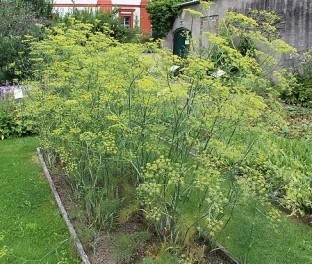
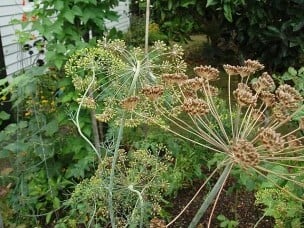
 Dill, Anethum graveolens, has been grown and used for thousands of years. Dill is a native of the Mediterranean area and is an important part of northern European cuisines. It is an annual herb that will reseed if it likes where it is growing, and is one of the first herbs to appear in the spring garden. The foliage, often referred to as “dillweed,” is a tasty addition to fish, chicken, eggs, cucumber, and potato dishes. The yellow flowers that form on top of 2-3 foot stems appear in clusters which then become the seeds. The seeds are ready to harvest when brown and are used in pickling, vinegars, breads, and crackers.
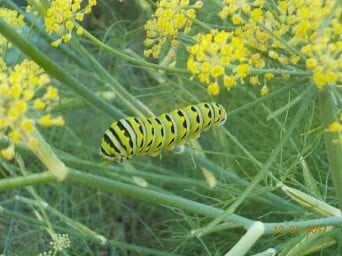
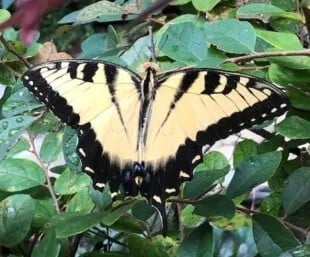
Dill is a good companion plant in the garden because it “attracts beneficial insects including lacewings and syrphid flies, both of which prey on aphids, and it has few problems with pests. In fact, one of the only pests for dill is the larval stage of an insect that is beneficial as an adult: the black swallowtail butterfly” (Albornoz, 2014). The feathery green foliage is indeed a favored food of the Eastern swallowtail and anise swallowtail butterfly caterpillars. These butterflies are a welcome visitor to any garden.
Ancient Greek medical texts talked about dill as a cure for headaches and stomachaches. Dill seeds were found in the tomb of Amenhotep II, an Egyptian pharaoh who reigned from 1427 to 1401 BCE. The Bible, in Matthew 23:23, mentions dill as a tithing currency, demonstrating the importance of the herb in everyday living at that time. Romans considered it a good luck symbol. Recognizing the antibiotic properties of dill, gladiators used it on their bodies to prevent infection and to give them courage. Roman war heroes were crowned with wreaths of dill when they returned home and dill flowers were hung in Roman banquet halls. During the Middle Ages, it was thought that dill would deter witches and that “an evil eye spell could be combated by carrying a bag of dried dill over the heart” (Kowalchik & Hylton, 1998). Early Americans carried dill seeds in their pockets to quell hunger during long church services. Eastern European immigrants brought dill with them to use in cooking and in food preservation.
 Many European and Asian cultures used dill for its medicinal qualities. In fact, the word “dill” stems from the Norse word “dilla” which means to lull or soothe. Indeed, some of its oldest medicinal uses (for which it’s still used today) were to soothe stomach problems, aid insomnia, and increase lactation in breastfeeding women. Traditional and Ayurvedic medicines today recommend “gripe water,” an infusion of dill seed in water, as a sleep and digestive aid, especially for children. Dill is more commonly used in Europe and Asia as a medicine than in the US. There is ongoing research to verify the traditional medicinal applications of the herb. According to Nutrition Today, “recent clinical trials evaluated dill and its extracts for managing risk factors for diabetes and cardiovascular disease, as well as in improving outcomes during labor and delivery.“ One author states: “Talk about a useful organism – dill has also been known to stop the growth of certain bacterium such as E. coli, and streptococcus (staph infection)!” (Krumke, 2012).
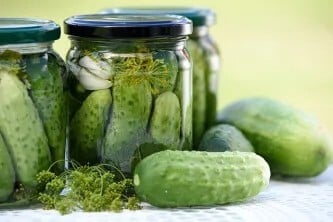 Besides being used in the food industry to make dill pickles, dill also flavors some Aquavit liqueurs and is used to perfume cosmetics, detergents, mouthwashes, and soaps.
For more information about this ancient herb, please visit The Herb Society of America’s Essential Guide to Dill.