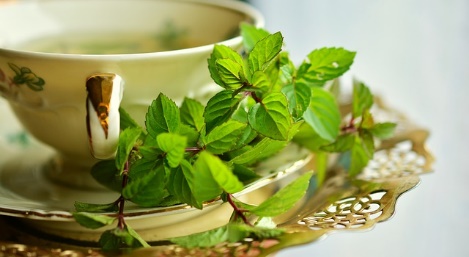
 My herb spiral is my mad scientist laboratory. Just outside my kitchen door, it is the only part of my garden to experience full sun. The soil is much-amended with compost. And, that is where I plant essential kitchen herbs and the occasional experiment, like a new herb that bears close watching.
However, over the last few gardening seasons, it has devolved largely into a jungle of mint. Mystery mint. Muddle mint. A promiscuous genetic mix of whatever mint I have ever planted, plus whatever mint blew in on its own. In my defense, that’s what mint does. And sometimes, the result is something else.
Peppermint (Mentha x piperita) is a hybrid plant, a cross between water mint (Mentha aquatica) and spearmint (Mentha picata). It was first mistakenly identified by Linnaeus in 1753 as a separate species, and can self-propagate by root (exuberantly) both in the garden and in the wild. But peppermint can also pop up spontaneously among its parent plants. Because it is a hybrid, peppermint cannot set fertile seed. Peppermint is fond of damp places, like stream beds, and isn’t at all particular. In places where it was introduced for its oil, peppermint has broken free and is now considered invasive. Even where a gardener uses best practices and plants peppermint sunken in a pot to segregate its rhizomes from the rest of the garden, it will break free.
The leaves and flower tops of either wild or cultivated peppermint may be harvested and dried. Cultivated specimens produce more potent oil. Peppermint has a warm, sweet aroma and taste, which is soothing to the digestion and freshening to the breath and palate. Some people feel that it repels mice, but recent experiments in my pantry are inconclusive. It is also supposed to be a deterrent to spiders, although I have never wanted to deter spiders. Peppermint oil applied externally can ease the soreness of muscle or arthritis pain. And a freshly brewed peppermint tea is clearly soothing to body and soul.
 So, how did peppermint come to be associated so strongly with Christmas? It’s hard to say. It’s not evergreen, like so many Christmas plants. It’s not red, although most peppermint-flavored foods are represented in a red and white striped form, like candy canes. But candy canes themselves, introduced in the 1670’s by a choirmaster in Cologne to quiet children in church, were made from plain white sugar candy and bent into a shepherd’s crook shape as a nod to the Christmas.
Bicolored candy canes seem to have first appeared in the 19th century in the United States. Although there was a patent awarded in the 1920’s for a candycane producing machine, it wasn’t until the 1950s that Bob’s Candy, in Albany, Georgia, came up with a candy-making machine that produced the twisted red-and-white spiral that we now think of as classic candy cane. Those peppermint spiraled candy canes were explosively popular…and were flavored with peppermint. So, like Rudolph the Red-Nosed Reindeer, the classic candy cane seems to be a mid-century American Christmas innovation. And, from there, “Went down in hi-sto-ry!”