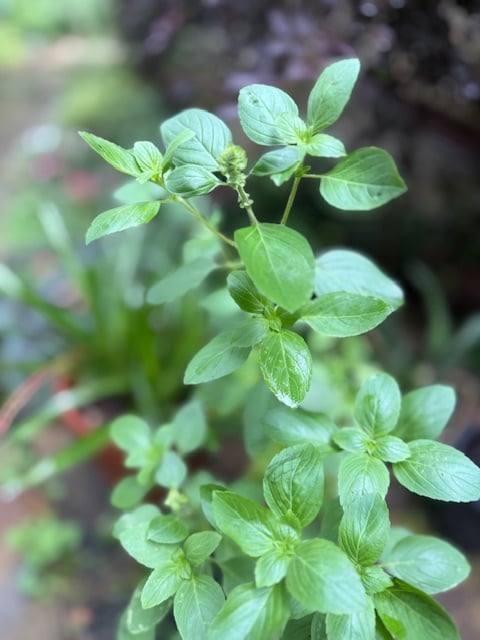
 Lemon basil, Ocimum × africanum Lour., also known as hoary basil for its whiskery stems, “temperate” tulsi because it grows in temperate zones, and African holy basil for its medicinal uses in East Africa, is The Herb Society’s Herb of the Month for June. It is also native to northern India.
I have grown lemon basil in my garden for many years. The bright green leaves and their fragrance are among the reasons I keep growing it. It thrives in the heat and humidity of my Zone 9 garden. It is an annual, but it is easily propagated by taking cuttings, rooting them in water or soil, and keeping the young plants in a warm place over the winter. In early spring, the plants are ready to take their place in the garden, attracting pollinators and providing many green, fragrant leaves and stems for salads or for use in fragrant bouquets and garnishes.
The plant can easily reach 2-3 feet tall, but it benefits from frequent trimming. Those trimmings can be shared with friends or used to propagate new plants. It is an herb that generously shares itself.
In the Kitchen
Lemon basil is commonly used in Southeast Asian cuisines. It is added to soups, stews, curries, noodle dishes, and fish dishes. In the Philippines, the seeds are soaked in water and used in sweet desserts. In Lao cuisine, it is the key ingredient in the popular stew called lam. In Thailand, the leaves are used as a vegetable and in curries.
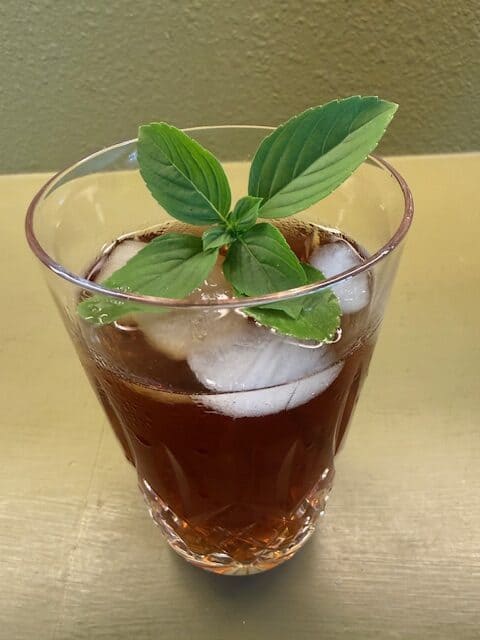
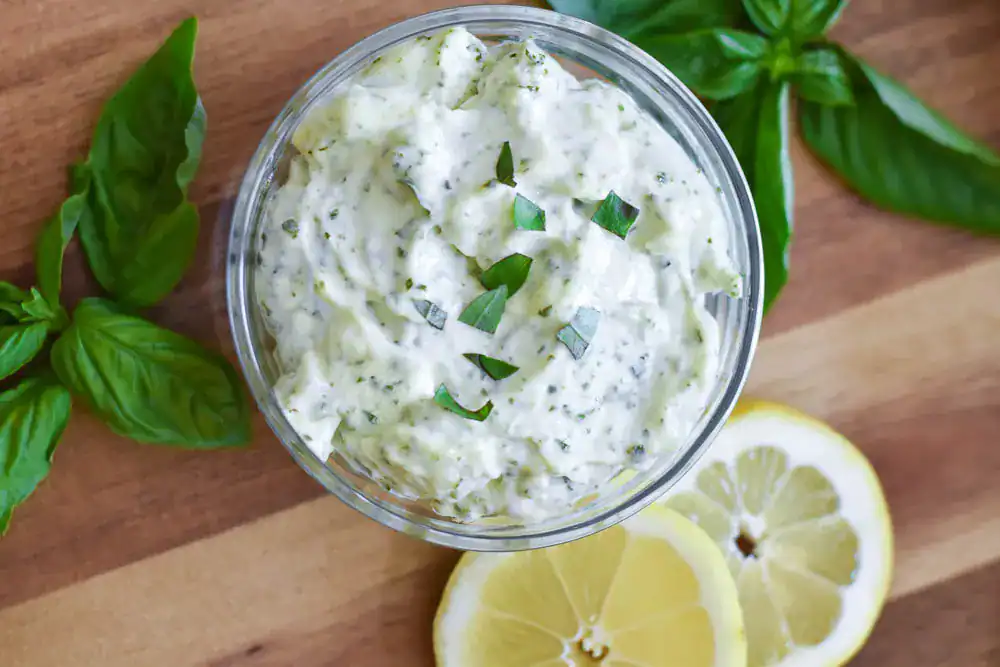 Lemon basil’s stems make a perfect garnish for lemonade, iced tea, or cocktails. The leaves are good in salads, dressings, and rice and noodle bowls. They can also be minced and mixed with fruit. Even the white flowers are edible, adding a fragrant touch to salads. As a bonus, the bright green leaves and citrus fragrance will energize and uplift you while you use them in the kitchen.
In the Apothecary
Only recently did I learn that this basil is considered the Holy Basil of Africa because of its traditional medicinal uses. Studies have shown that the plant contains numerous medicinal compounds, such as eugenol, citral, and linalool, which are well-known antioxidants. However, there remains a gap between knowledge of these properties in African basil and research demonstrating its health-promoting effects on the body. But research aside, the plant has been used in Africa and Southeast Asia for many years to treat coughs, as an expectorant, for headache relief, and as an anti-flatulent and antiemetic. In Thailand, lemon basil leaves are also used in curries to increase lactation, and the seeds are used for weight control and as a laxative. Animal studies are also examining its effects on gastric ulcers (Bunwijit, 2017).
A Future for Lemon Basil
 The global herbal supplements market is projected to reach USD 94.3 billion by 2032, up from USD 48.3 billion in 2022 (Yardi, 2026). As interest in natural herbal remedies has grown, more research is underway to cultivate traditional medicinal plants for medical use. Recent research has shown that growing African basil in the U.S. can be profitable. Lemon or “temperate tulsi” basil is being investigated as a possible crop for Oregon’s Willamette Valley because two harvests of the plant are possible in one season (Cross, 2025). Multiple harvests of the basil do not reduce its eugenol content, further incentivizing its cultivation as a pharmaceutical crop.
In Africa, lemon basil leaves are used as an insecticide and larvicide to protect crops from insect damage after harvest. It is also used to repel mosquitoes, making it a good candidate for planting near your patio or porch.
I wish I had known all this about lemon basil a month ago. I could have sold many more lemon basil plants at our unit’s herb sale! For more information about lemon basil, please visit The Herb Society of America’s website.