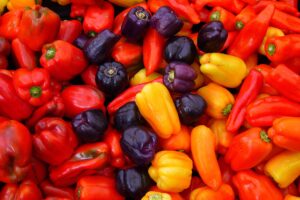
 Few herbs capture attention quite like the chile pepper. Vibrant, fiery, and surprisingly diverse, Capsicum annuum includes thousands of peppers ranging from gently warm to intensely hot. Their fruits come in an array of shapes and sizes, glowing in shades of red, green, purple, yellow, and orange. With nearly 4,000 varieties known worldwide, chile peppers are one of the most colorful and flavorful members of the herb garden.
This month, we are taking a closer look at two small but powerful peppers often confused with one another: chile pequin and chiltepin. Both are staples in Mexican and Tex-Mex cuisine, and despite their size, they deliver remarkable flavor and heat.
A Peppery History
To understand chile peppers, it helps to start with a bit of spice history—specifically the relationship between chile peppers and black pepper (Piper nigrum).
 When explorers encountered black pepper in the Far East and brought its prized black fruits back to Europe, the spice quickly became a sensation. For centuries, black pepper was valued for its ability to enliven otherwise simple foods. Demand soared so high that peppercorns were sometimes used as currency, and only the wealthy could afford generous amounts.
In 1492, while searching for a new route to the lands where black pepper grew, Christopher Columbus landed in the New World. Instead of peppercorn vines, he encountered a completely different plant producing fiery fruits that were even hotter than the spice Europeans knew. Believing he had reached India, Columbus called them “peppers”—a name that has caused confusion ever since (Ford, 2022).
In reality, the black pepper of Asia and the chile pepper of the Americas are unrelated plants. Yet once Spanish and Portuguese explorers introduced chile peppers to Europe, Africa, and Asia, their popularity spread rapidly. Over time, these vibrant peppers immensely enhanced global cuisine and eventually challenged black pepper’s dominance in the spice trade.
Archaeological evidence shows that the peoples of Central and South America had been eating wild chile peppers for thousands of years. Remnants dating back to around 7200 BCE have been discovered. As Matt Turner notes, this makes peppers “one of the first documented spices used by humankind anywhere in the world.”
Chiltepin vs. Chile Pequin
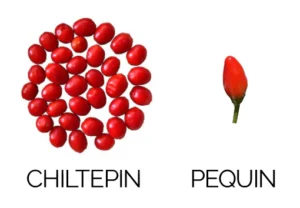
Although often mistaken for one another, chiltepin and chile pequin each have their own personality.
Chiltepin: The Mother of All Peppers
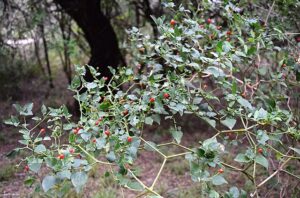 The chiltepin pepper—sometimes spelled chile tepin—creates a striking sight in the fall. The plant produces tiny, bright red berries that shine like jewels and attract birds.
This pepper grows mainly in the wild and is believed to be the ancestor of all domesticated chile peppers. For that reason, it is often called the “Mother of All Peppers” (Hultquist, 2020). It is also the only pepper native to the United States and is protected in some national parks in the Southwest. In recognition of its heritage, Texas named the chiltepin the state’s native pepper (Turner, 2009).
Despite their small size, chiltepin fruits are extremely hot, measuring about 75,000 Scoville Heat Units (SHU). For comparison, jalapeños average around 5,250 SHU. Yet chiltepins are prized not only for heat but also for their flavor—bright, fruity, and tangy, with a quick burst of heat that fades relatively fast.
Traditionally, chiltepins are crushed into soups and stews or steeped in vinegar to create intensely hot sauces—sometimes even hotter than Tabasco. Native American communities used them in cooking long before European contact, and their popularity continued through early American history. Thomas Jefferson was known to grow chiltepins in his garden as early as 1813.
Chile Pequin: Smoky Heat with Staying Power
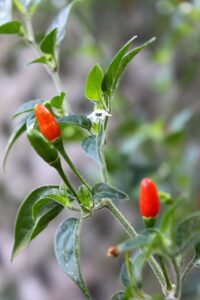 Chile pequin plants look very similar to chiltepin, which is why the two are often confused. Native to Mexico, the pequin produces small peppers that ripen to red, though both green and red fruits are used in cooking. The peppers are slightly larger than chiltepin and have a pointed tip that grows upright on the plant.
The key difference lies in flavor and the experience of heat. Chile pequin peppers have a citrusy, slightly smoky taste that becomes even richer when dried. This makes them especially popular in barbecue rubs and sauces.
While somewhat milder than chiltepin—averaging around 50,000 SHU—the heat of chile pequin builds gradually and can linger for up to 15 minutes, creating a slow, warming burn that many pepper lovers enjoy.
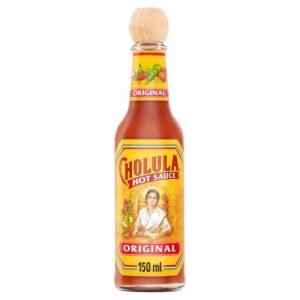
Chile pequin is also the main pepper used in the well-known hot sauce Cholula, named after one of the oldest continuously inhabited cities in North America. The pepper is widely used in fresh salsas and many classic Mexican and Tex-Mex dishes.
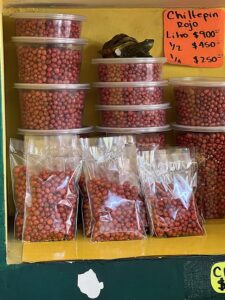
Although fresh chiltepin and chile pequin can be difficult to find in typical grocery stores, dried peppers are readily available and offer an easy way to explore their flavors.
From the Wild to the Apothecary
 Chile peppers have long been valued not only for flavor but also for their medicinal uses. The Aztecs and Mayans used them to treat stomachaches, skin conditions, arthritis and rheumatism pain, and even as a remedy for snake bites (Faisal, 2025). Early Texas settlers continued this tradition, making chile-based cough syrups or swallowing the fruits whole to help fight colds.
Much of the pepper’s medicinal value comes from capsaicin, the compound responsible for its heat. Modern research supports the use of capsaicin in topical treatments for arthritis and other pain conditions. In simple terms, the intense sensation produced by capsaicin can interrupt pain signals, providing relief (Turner, 2009).
Chile peppers are also nutritionally impressive. They provide vitamins A, C, and E, along with several B vitamins. In addition, a large study involving more than 570,000 participants across multiple countries found that people who regularly ate chile peppers experienced a “26% reduction in cardiovascular mortality, a 23% reduction in cancer mortality, and a 25% reduction in overall mortality” (American Heart Association, 2020).
From ancient hearths to modern research labs, chile peppers continue to prove their value. Their bold colors, lively heat, and long history make them one of the most interesting herbs we can grow and enjoy.
And with The Herb Society of America’s upcoming conference in San Antonio, Texas, April 15–17—aptly themed “It’s Spicier in Texas”—these fiery little peppers feel especially timely.